Salary Certificate UAE Format: Complete Guide to Getting, Using And Attesting It
Salary Certificate UAE. If you have ever applied for a loan, a new visa, or even a simple rental agreement in the UAE, chances are someone has asked you for a “salary certificate.” For many employees this is the first time they come across this document, and it can feel confusing at first. What does it contain? Who issues it? Why do banks, landlords and government offices all want a copy?
This guide breaks down everything about the salary certificate in the UAE what it is, why it matters, how to request one from your employer, how to get it attested and the common mistakes people make along the way.
What Is a Salary Certificate in UAE?
A salary certificate is an official letter from your employer that confirms your job, your position and your monthly income. It is printed on the company’s letterhead and carries a signature and stamp from an authorized person, usually someone from HR or a senior manager.
Unlike a salary slip which you receive automatically every month a salary certificate is only issued when you specifically ask for it. It gives a full picture of your employment your designation, your basic pay, your allowances, and sometimes the total (gross) salary you earn.
Salary Certificate vs Salary Slip
People often mix up a salary certificate with a salary slip, but they serve very different purposes. Here’s a simple comparison:
| Feature | Salary Certificate | Salary Slip |
|---|---|---|
| Purpose | Acts as proof of employment | Acts as proof of payment |
| Frequency | Issued only when requested | Issued every month automatically |
| Common uses | Visa applications, lease agreements, mortgages, loans, credit cards | General payroll record, tax filing |
| Information included | Designation, employment period, gross & net salary | Salary breakdown, benefits, deductions for that specific month |
In short, a salary slip shows what you were paid in a specific month, while a salary certificate confirms who you are, where you work and how much you earn overall.
Read Also: UAE Salary Check Balance Enquiry Online: A Complete Guide To FAB, WPS And Prepaid Card
Why You Might Need a Salary Certificate in UAE
There are several everyday situations where you’ll be asked to produce this document. Here are the most common ones:
- Renting a home: Landlords often want proof that you can afford the rent before signing a lease.
- Applying for a bank loan: Lenders need confirmation of a steady income before approving any loan.
- Filing foreign taxes: If you’re a resident of another country for tax purposes, this document proves your income earned in the UAE.
- Applying for a credit card: Banks assess your creditworthiness using the salary figures on this certificate.
- Visa applications or renewals: Immigration authorities want proof that you have a stable income and a reason to return to the UAE.
- Government-related paperwork: Some clearance procedures or utility registrations may require it.
- Family court matters: It can serve as evidence of your ability to support dependents or pay alimony.
Because it touches so many parts of daily life, it’s worth understanding exactly what should be included in it and how to get one without delays.
What Information Goes Into a UAE Salary Certificate
While every company designs its own certificate, most follow a similar structure. A properly issued salary certificate in the UAE usually includes:
- Employee details — full name, job title, and employee ID
- Employer details — company name, address, and official letterhead
- Employment details — start date and type of contract
- Salary breakdown — basic salary, allowances, and any deductions
- Total earnings — both gross and net salary
- The reason the certificate is being issued
- The date it was issued
- Signature and stamp of an authorized company representative
If any of these details are missing, the certificate may be rejected by the bank, embassy, or institution you’re submitting it to.

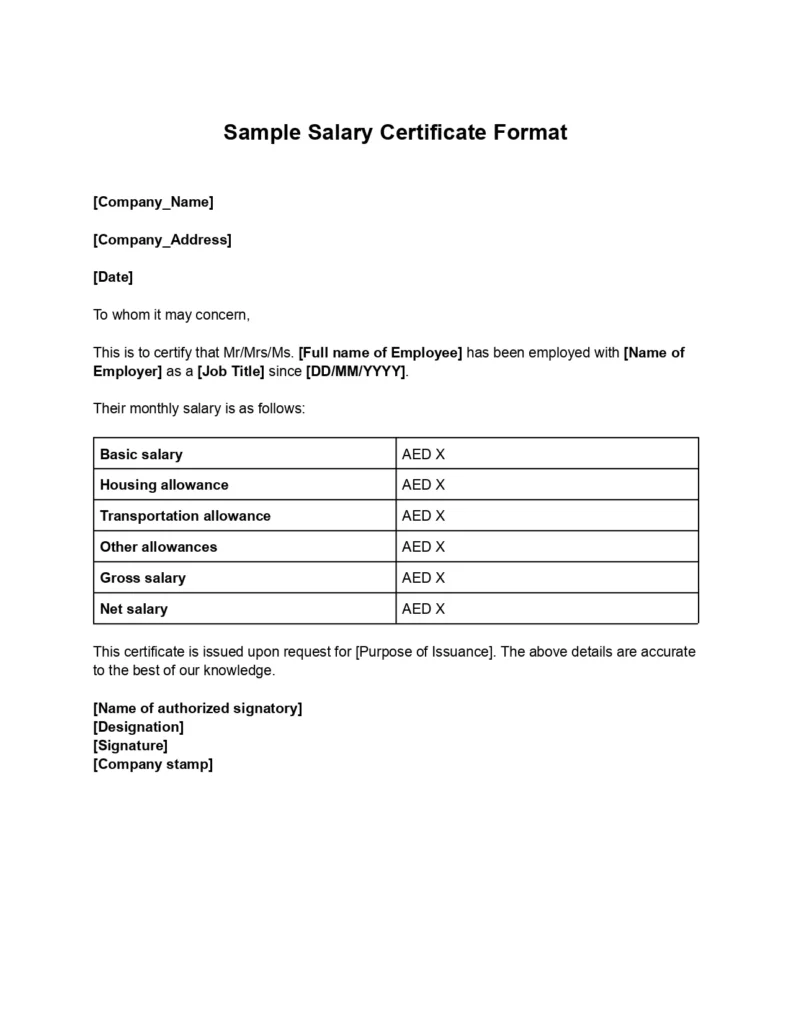
A Typical Salary Certificate Format in the UAE
Below is a simplified version of how a standard salary certificate is usually laid out:
[Company Name]
[Company Address]
[Date]
To whom it may concern,
This is to certify that Mr/Mrs/Ms. [Employee Full Name] has been employed with [Company Name] as a [Job Title] since [DD/MM/YYYY].
Their monthly salary details are as follows:
| Salary Component | Amount |
|---|---|
| Basic Salary | AED X |
| Housing Allowance | AED X |
| Transportation Allowance | AED X |
| Other Allowances | AED X |
| Gross Salary | AED X |
This certificate is issued upon the employee’s request for [Purpose of Issuance]. The details mentioned above are accurate to the best of our knowledge.
[Name of Authorized Signatory]
[Designation]
[Signature]
[Company Stamp]
A shorter version is also common, especially for straightforward visa or bank requests:
“We hereby confirm that Mr. [Employee Name] is officially an employee of our company. He is currently receiving a monthly salary of AED [Amount] inclusive of all fixed allowances. His designation is [Designation]. Please note that this letter does not constitute a financial guarantee or commitment of any kind, including but not limited to repayment of any loan, overdraft, or credit card facility, on behalf of the company.”
Both formats are acceptable, but the detailed version with a salary breakdown is preferred by banks and lending institutions, since it shows exactly how the total income is made up.

How to Get a Salary Certificate in UAE
Requesting a salary certificate is usually a straightforward process. Here’s how to go about it:
1. Reach Out to Your HR Department
Your company’s HR department is responsible for issuing salary certificates. Start by sending them a request, either through email or an internal HR system, depending on how your company operates.
2. Provide All the Necessary Details
When you make the request, clearly mention why you need the certificate and which organization it should be addressed to (for example, “for [Bank Name] loan application” or “for tenancy contract renewal”). Giving complete information upfront helps avoid back-and-forth delays.
3. Follow Up If It’s Taking Too Long
Most companies issue the certificate within 3 to 5 business days. If it takes longer than that, it’s completely reasonable to follow up with HR and check on the status.
Salary Certificate Attestation in UAE
If you plan to use your salary certificate outside the UAE for example, for a foreign visa application or overseas tax purposes you will likely need to get it attested. Attestation is simply the process of officially verifying that a document and its contents are genuine.
In the UAE, the Ministry of Foreign Affairs (MOFA) is the government authority responsible for attesting salary certificates. However, depending on your monthly income, there may be extra steps before MOFA attestation:
- If your salary is under AED 10,000: You’ll need to get an affidavit from IVS Global, and you may be asked to submit additional documents such as your bank statements and employment contract. Costs typically include around AED 30 for the affidavit, roughly AED 50 for delivery, and about AED 54 if IVS handles the attestation.
- If your salary is over AED 10,000: You’ll need a stamp from the Chamber of Commerce in addition to the affidavit. This step is provided free of charge.
How to Get Your Salary Certificate Attested
Here’s the full process broken down into simple steps:
Step 1: Request the Certificate from Your Employer
Start by contacting your HR or relevant department to issue the certificate, making sure all required details are included so it doesn’t come back incomplete.
Step 2: Complete the Pre-Attestation Process
Before submitting the certificate to MOFA, you may need to go through preliminary steps — such as obtaining an affidavit or a Chamber of Commerce stamp, depending on your salary bracket.
Step 3: Register on the MOFA Website or App
You can complete the attestation process online through the MOFA website or mobile app. Signing in with your UAE Pass makes registration quick and simple.
Step 4: Submit the Document and Choose a Delivery Method
On the platform, select “Attestation of Official Documents, Certificates,” specify that the document is a salary certificate, and enter the place of issue. Don’t forget to attach the pre-attestation documents and stamps. You can then choose to:
- Receive a physical copy by courier
- Get it delivered digitally
- Pick it up yourself from the nearest Customer Happiness Center
Step 5: Pay the Attestation Fees
Once your document is uploaded, you’ll be asked to pay the applicable fee, generally ranging between AED 150 and AED 200, payable directly through the platform.
Is a UAE Salary Certificate Valid Outside the Country?
In some cases, even after MOFA attestation, a foreign institution — such as an embassy or consulate — may require additional attestation from their own end before accepting the document. Every embassy has its own rules and fee structure, so it’s a good idea to check with them in advance so you’re not caught off guard.
Know Your Rights as an Employee
It’s important to understand where you stand legally when it comes to requesting a salary certificate in the UAE:
- You have the right to request a salary certificate at any time and for any valid reason.
- Employers are legally obligated to provide a complete and accurate certificate.
- If your employer refuses to issue one, or gives you a document that isn’t usable, you can file a complaint with the Ministry of Human Resources and Emiritisation (MOHRE).
Common Mistakes to Avoid When Requesting a Salary Certificate
To make sure your certificate gets accepted without delays, especially during attestation, keep this checklist handy:
- Double-check that your name, job title, and salary figures are correct
- Make sure the purpose of the request is clearly stated
- Confirm the company letterhead, stamp, and signature are all present
- Verify that the pre-attestation stamp (if applicable) is clearly visible
Even a small error, like a misspelled name or a missing stamp, can cause your document to be rejected, so it’s worth reviewing it carefully before submission.
Why a Salary Certificate Matters So Much
A salary certificate plays a bigger role than most people realize. Here’s why it holds so much value:
Proof of Income
For almost any financial activity loans, credit cards, mortgages lenders need solid proof of your income. A salary certificate is one of the most trusted documents for this purpose because it comes directly from your employer.
Proof of Employment
Beyond income, it also confirms your job title and your standing within the company, which matters in many legal and financial dealings.
Helps With Financial Planning
Having a clear, documented breakdown of your income makes it easier to plan for the future — whether that’s saving for retirement, your children’s education, or buying a home.

How Employees Use Their Salary Certificate
Let’s look a little deeper at the specific situations where this document becomes essential:
- Loan Applications: Banks won’t process personal, car or home loans without proof of steady income. Your salary certificate gives lenders confidence that you can repay what you borrow.
- Visa Processing: Most visa applications whether for travel, work, investment, family sponsorship or study ask for a salary certificate covering the last 3 to 6 months. It reassures immigration authorities that you can financially support yourself.
- Rental Agreements: Landlords frequently request this document to confirm you can comfortably afford the monthly rent before signing a lease.
- Credit Card Applications: Banks use your salary details to determine your creditworthiness and decide how much credit limit to offer.
- Tax Filings: If there’s ever a mismatch between your declared and actual income, a salary certificate provides clear proof of your earnings.
- Legal Proceedings: In certain court cases, individuals may need to present this document as evidence of their income source.
FAQs About UAE Salary Certificates
How long does it take to get a salary certificate in the UAE?
Ans: Most companies issue it within 3 to 5 business days after you submit your request to HR.
Is a salary certificate the same as an employment letter?
Ans: Not exactly. An employment letter simply confirms you work at a company, while a salary certificate goes further by including your salary breakdown and other financial details.
How long is a salary certificate valid for?
Ans: It’s typically valid for around three months from the date it was issued, though this can vary depending on the requesting institution.
Can I request a salary certificate more than once?
Ans: Yes, you can request one as often as you need. Employers are required to provide it whenever a valid request is made.
Do I need to pay my employer for a salary certificate?

Ans: No, issuing a salary certificate is part of your employer’s responsibility and is usually provided free of charge.
What should I do if my employer refuses to give me a salary certificate?
Ans: You can file a complaint with MOHRE (Ministry of Human Resources and Emiritisation) if your employer refuses or delays without valid reason.
Is attestation always required for a salary certificate?
Ans: No, attestation is only necessary if you’re using the certificate outside the UAE, such as for a foreign visa or overseas tax matter.
How much does salary certificate attestation cost in the UAE?
Ans: Costs vary based on your income level and the steps involved, but MOFA attestation generally costs between AED 150 and AED 200, with additional smaller fees for affidavits or Chamber of Commerce stamps if applicable.
Can a freelancer or self-employed person get a salary certificate?
Ans: No, a salary certificate is specifically issued by an employer to a salaried employee. Freelancers usually need to provide bank statements or trade license documents instead.
What happens if there’s an error on my salary certificate?
Ans: You should immediately contact HR to have it corrected and reissued, since even small mistakes like a wrong figure or spelling error can lead to rejection by banks or embassies.
Final Thoughts
A salary certificate might seem like a small piece of paper, but it plays a big role in your financial and legal life in the UAE — from renting a home to applying for a visa or a loan. Knowing exactly what should be in it, how to request it properly, and when you need it attested can save you a lot of time and hassle down the road. Keep this guide handy the next time you need to request one, and you’ll know exactly what to expect at every step.

About The Author